- Empty cart.
- Continuer vos achats

Two Paintings Looted During the Occupation Offered to the Louvre by a Family
- Posté sur
Cyril CH
- Catégories: Culture,Featured English
Mise à jour 10 juin 2024 par Redak
A Historical and Symbolic Restitution
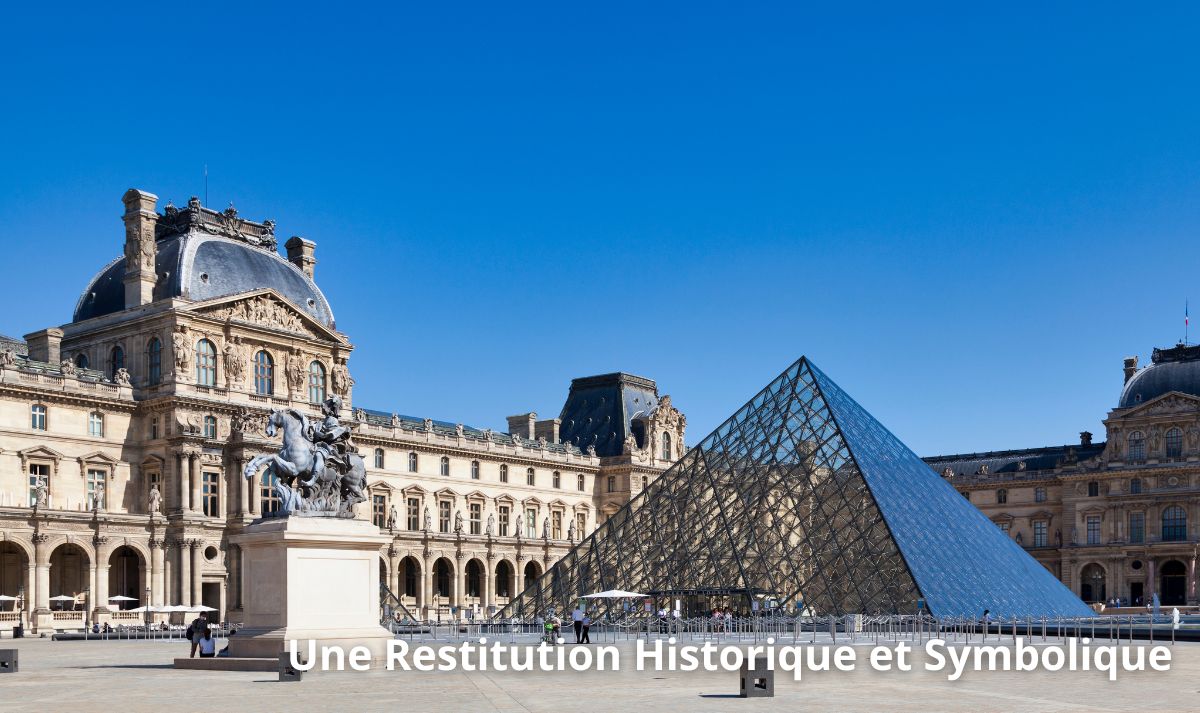
Two 17th century still lifes, plundered by the Nazis during the Occupation and exhibited at the Louvre Museum since the 1950s, were returned to the 48 beneficiaries of a Jewish family. They decided to donate these works to the famous Parisian museum. The paintings, “Still Life with Ham” by Floris van Schooten and “Food, Fruit and Glass on a Table” by Peter Binoit, probably painted in 1630 and 1620, will be visible to the public again from Wednesday.
A Ceremony Full of Emotions
A large part of the family’s descendants, as well as their children and grandchildren, gathered around the two paintings on Tuesday. Marion, one of the rights holders, expressed to AFP the importance of this act to preserve the memory of her family, despoiled and persecuted during the Second World War. “It is a duty of remembrance towards my family, whose history speaks to current generations”, she stressed.
Marion was the main point of contact in the procedures which allowed this restitution after a long research work and considerable energy. She considers this exhibition as a testimony to the diversity of destinies within her family, some having been deported, others having resisted and survived by hiding.
The Louvre Commitment
Laurence Des Cars, president and director of the Louvre, described this restitution as“a call to never forget, a commitment to transmitting memory and a constant reminder to action”. This statement highlights the importance of collective memory and recognition of past injustices.
MNR Works and the Role of Genealogists
The two paintings, whose provenance was long unknown, were classified as “National Recovery Museums” (MNR) works, a status given to looted works not returned after the war. The beneficiaries of the Javal family, five members of which were deported and murdered at Auschwitz, were able to be identified thanks to the joint efforts of researchers from the French Ministry of Culture, the National Archives and the Commission for Compensation for Victims of spoliations (CIVS), with the help of genealogists.
Research revealed that the two paintings, considered by the Nazis to belong to the Juralides collection, were in reality the property of Mathilde Javal. Her private mansion in Paris had been occupied and emptied in 1944. A letter from Mathilde Javal, written in 1945 to request the return of her family’s works of art, was decisive in tracing the history of the paintings and will be presented in the ‘exposure.
A Collaboration for Memory
In 2015, an agreement with the Ministry of Culture allowed Généalogistes de France to carry out free research to identify the living rights holders of six owners of “MNR” works, including the Javals.
Between 1940 and 1945, around 100,000 cultural items were looted in France, mainly from Jewish families, by the Nazi regime and the Vichy Government. At the end of the war, around 60,000 works were returned to France, of which 45,000 were returned to their owners. Of the remaining 15,000, around 13,000 were sold by the State and 2,200 entrusted to national museums. These works, of which the Louvre is responsible for 1,610, are designated under the “MNR” status and do not belong to the national collections.
